Haiku, a generative music album for Mac OS from the 大雨-Ooame project
An album in the form of software.
Haiku is a generative music album for Mac OS that builds its own sound from nothing each time you open it, and never plays the same way twice —
a record that exists only while it is playing. Discover my project 大雨 — Ooame here
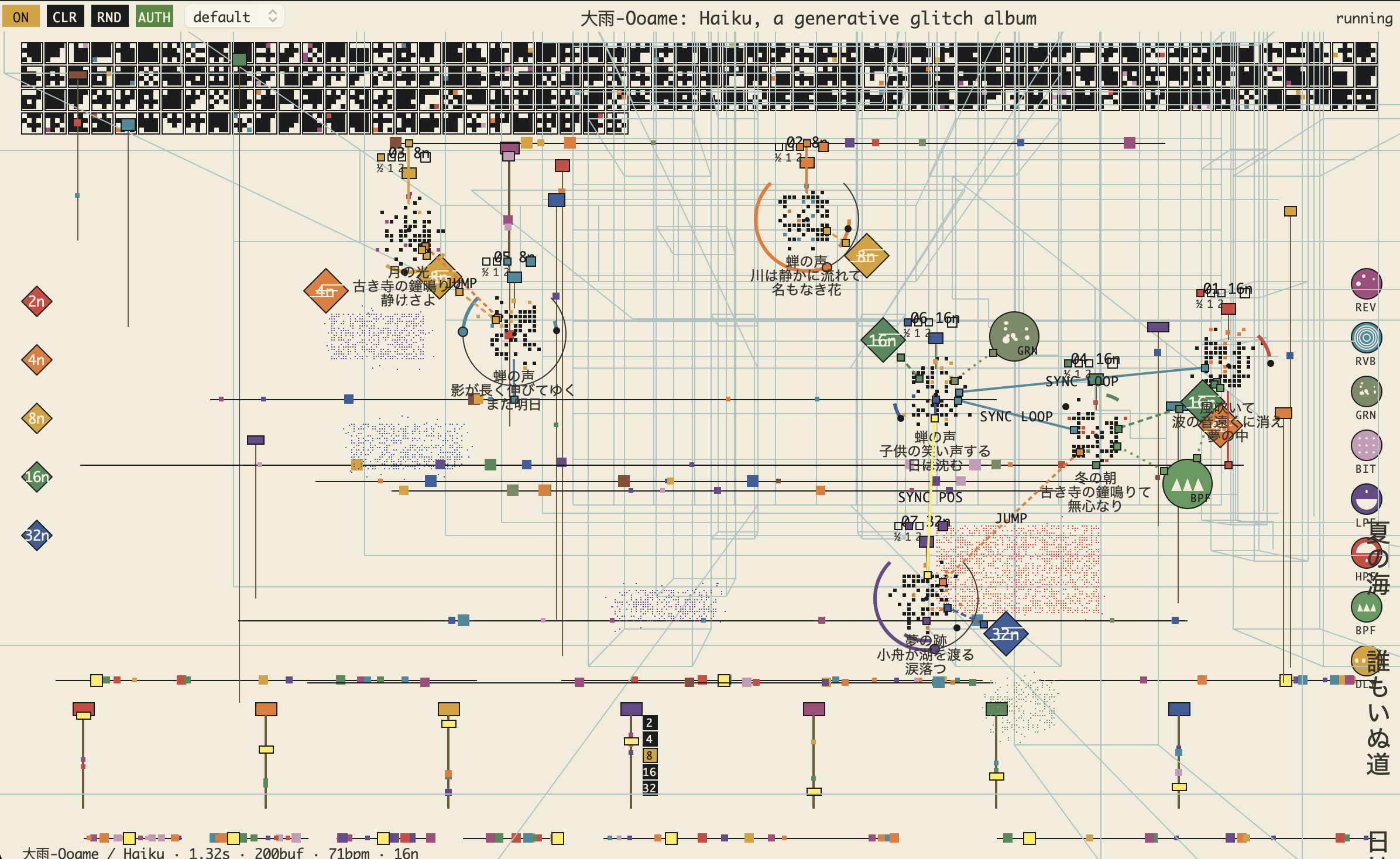
GLEETCHLAB2021 gets an OS update
Gleetchlab2021 has been updated for Mac for M processors running the latest OSX.
Download the software here
Les Jardins Secrets
“Les Jardins Secrets” can be understood as a refined exercise in sonic alchemy: an immersive work in which sound becomes a living substance, destined for perceptive and imaginative transformation. More than a simple electronic composition, it is a process of transmutation in which sound design takes on an almost philosophical dimension, reshaping the boundaries between the audible and the conceivable. In this context, the artist becomes a sort of sonic alchemist, manipulating acoustic textures and timbral properties to forge a new poetics of imaginary space.
The acoustic universe of “Les Jardins Secrets” is disconnected from the physical world. The spaces it evokes do not exist, nor do they seek to exist; they are purely mental constructs, soundscapes that emerge exclusively in the listener’s interior world. It is not a metaphorical representation of reality through sound, in which field recordings or familiar noises are recontextualized to evoke meaning. Instead, the work is entirely constructed through computer-generated simulations of “meta-sonic objects”: artificial sound bodies governed by existing physical laws, but impossible to realize.
These simulated objects challenge the material limits of reality. gemstones and precious metals, for example, are not simply sampled or symbolized, but reinvented as functional instruments in a speculative 21st-century lutherie. Through this imaginative reengineering, the impossible becomes audible: an unprecedented music of objects, a soundscape of elsewhere, born entirely from thought but rendered with the tactile precision of physics.
In Les Jardins Secrets, the act of listening becomes an act of exploration: a wandering through impossible gardens where sound does not describe, but is the place.
SUBSTANTIA 1.3 UPDATE
Substantia is now compatible with Mac OS 15
仲間 NAKAMA
We are all familiar with the effects of echo and delay. These are undoubtedly among the oldest and most common sound processing techniques. During my studies to become a sound engineer, using old magnetic tapes, I found great enjoyment in creating increasingly intricate and extended delays and loops.
It is almost unnecessary to emphasize that tape imparts a unique character to the sound of delay, one that is markedly different from its digital counterpart. It’s something that we easily appreciate. This is likely because the ear tends to favor imperfections, perceiving them as natural, in contrast to the machine precision of digital sound. Nevertheless, tape-based delays and loops come with various limitations that inevitably impose constraints on our work. Beyond the obvious physicality of the tape medium—which demands space, costs, and maintenance—magnetic tape does not easily allow for manipulation of time.
Yet, as Stockhausen taught us, time is an essential and incredibly complex parameter of music.
We are not uncovering anything new, of course. What I am discussing is well-established history. However, the manipulation of time remains, even in the 21st century, a vast field of musical exploration. The reason lies in digital technology, which allows us for example, to create delays (or loops) of significant lengths—indeed, lengths that would be nearly impossible to achieve with magnetic tape without considerable effort.
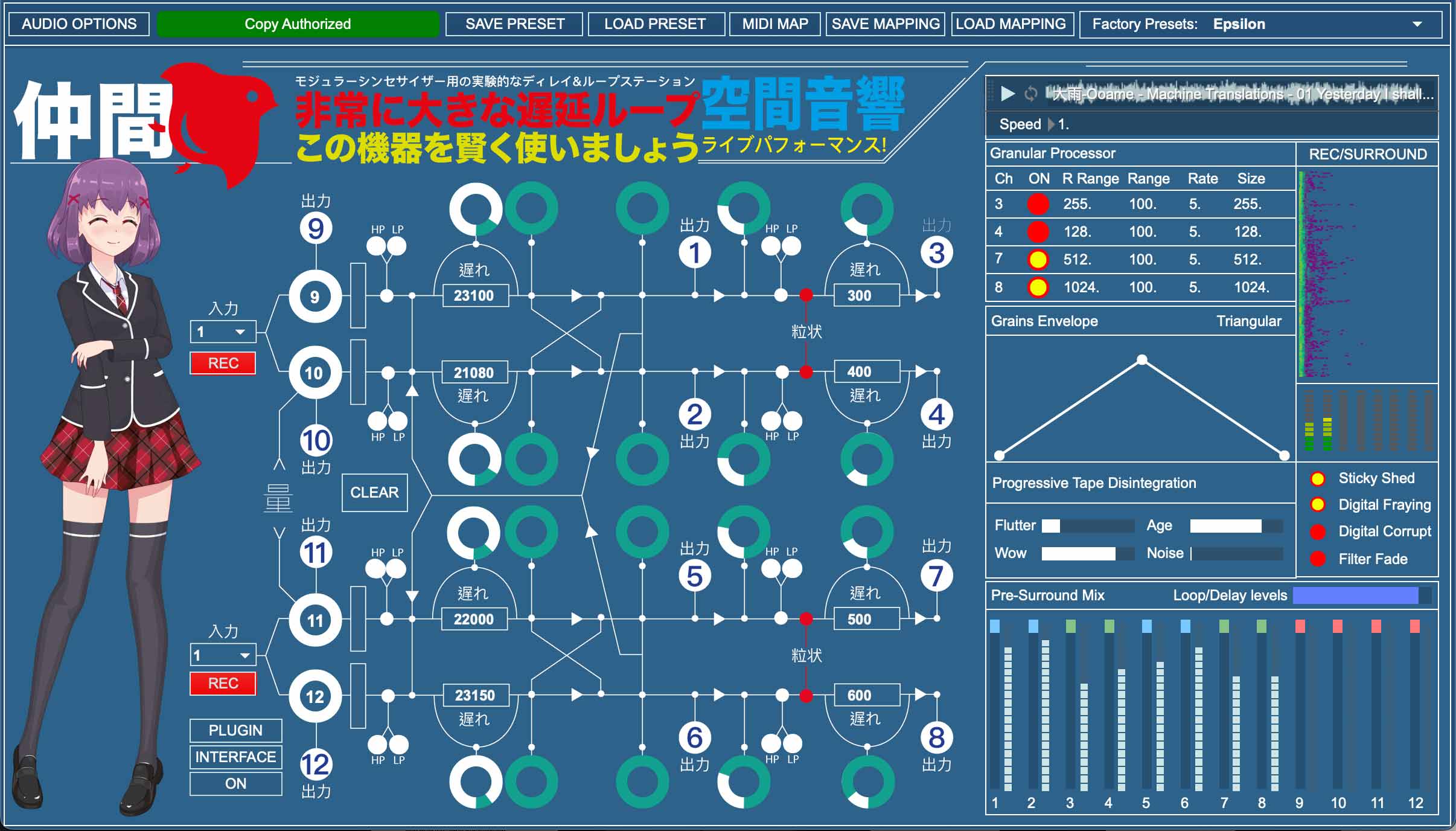
Nakama has eight signal processors (delay/loop) capable of recording and delaying an audio signal from one millisecond to one hour. This capability, rare even among modern digital delays, is further enhanced by the fact that everything occurs in a spatial context. I envisioned Nakama primarily for those artists who increasingly perform in surround sound settings. While Nakama can certainly be used in a stereo configuration within a home studio, its foundational concept is to exploit large-scale delays and loops within a surround sound environment, in 4 or 8 channels.
One of the most fascinating aspects of delay is the principle of feedback. Essentially, the musician controls the number of repetitions of a delayed signal by adjusting an amplifier that connects the delay’s output back to its input. Each time the signal is feed back to the delay input, its volume typically decreases (an increase would spell trouble for the speakers). This seemingly simple feature of delays sparked my curiosity. I found it intriguing that the sound changes in some way with each iteration. But what if I didn’t limit this change to just the volume?
In tape echoes, due to purely physical reasons, the volume changes in parallel with the sound’s timbre. The amplifiers, as well as the processes of writing to and reading from the tape (or metal drum), especially in tape echo machines—not hi-fi recorders—do not reproduce exactly the same sound but gradually filter it more with each repetition. Add to this, the imperfections in the motor’s rotation. But wait, there’s more, much more… indulge me in this short digression.
One of my most dangerous passions (for my wallet) unrelated to music, is the collection of intaglios on semi-precious stones from the Assyrian, Roman, and Greco-Egyptian periods. The Romans were avid collectors of rings adorned with gems, engraved with depictions of deities, mythological themes, or amulets bearing magical inscriptions. In a sense, for the Romans, signet rings were a kind of social network of the time. First of all, they were widespread across all strata of the population (there were glass pastes for those who could not afford a stone carving), secondly, they defined social status, and finally, they represented the ideas with which the ring’s owner identified. It is precisely during the Imperial period that Western civilization began to collect art.
The stones I collect in my glyptotheque are ancient, spanning tens of centuries; some even date back to a thousand years before Christ. I also own modern rings with engraved gems, which I oftern wear, crafted using the same techniques and materials as those of the Hellenic era. I always observe them and feel an indescribable sense of vertigo. They will outlast me, and in 20 or 30 centuries, they will likely remain practically intact—who knows, perhaps they will be displayed in a museum or in the home of another collector.
Why am I sharing this story about rings with you? Because it has led me to reflect deeply on how much of the art we produce today is destined for oblivion. There is no art more fragile and impermanent than technological art—installations, CDs, web art, music on streaming platforms or vinyl, photography, short films etc, 3D… They are all on borrowed time, and that time is indeed brief.
So, if technological art is intrinsically fragile and short-lived, let us embrace and emphasize this fragility. Let us play with accelerating time and observe the inevitable transformation. Let the mutation be the message. After all, it is entirely natural for things to change over time.
Time is a powerful agent of change. Let’s put this change into sound.
I think there exists a fascinating and subtle thread connecting the issues of digital archiving, the concepts of “lossyness” and “hauntology,” the practices of artists like Alvin Lucier, William Basinski, Max Neuhaus, Robert Rauschenberg (to name a few) and the post-digital visions of Kim Cascone1. On one hand, significant efforts are dedicated to the preservation of digital and analog media. Digital “storage” in any form is not eternal. Hard drives have a limited lifespan, as do SD cards and CDs. This is why millennial formats like M-Discs, Microsoft Silica, or HoloMem have been developed and why significant archives (such as the Beatles’ discography) are continuously updated. However, these storage systems raise more questions than answers. The reliance on electrical power, artificial intelligence, dedicated software, and hardware provides no guarantee of millennial longevity; at best, one can speak of perspectives and hypotheses.
Interestingly (and perhaps predictably), art has at times sought to navigate in the opposite direction, incorporating the loss of information as a deontological practice. In some instances, artistic research has transformed into a voluntary pursuit of loss, embedding within the message the mark of a transformative impermanence. The slow and progressive alteration of the original material to the point of unrecognizability, and the lo-fi subculture, are fundamentally reactions to the pursuit of fidelity and, fundamentally, the eternalization of art.
For those who have studied physics, the model of sound processing I’ve added in Nakama’s feedback signal flow, might evoke memories of lectures on entropy. In a sense, that is the case. Starting from a system of low entropy and high information, Nakama slowly (or not so slowly) transforms the sound, increasing its entropy and thus reducing the amount of information. Eventually, after a certain number of iterations, what was once an orderly and crystalline sequence of synth or guitar notes (or whatever you like, also any audio file) becomes a shapeless bubbling matmos of sound. To this concept, I have added four granular processors, to extend the instrument’s syntax with a different kind of sound repetition.
Nakama is designed specifically for live performances and improvisation, where asynchronous sound is not a disturbance but a fundamental characteristic. This small software is intended to create a 360° sonic experience (although, of course, it can also perform perfectly well in a standard stereo setup). However, Nakama does not simulate surround sound through binaural algorithms; therefore, I encourage young musicians to consider a four-speaker setup for their home studios. They will discover immense potential in this little upgrade.
Anything played on Nakama can, of course, be recorded without the need to open a DAW. The software records in stereo, four, or eight channels, depending on the setup chosen in the surround matrix. Remember you can always open multichannel AIF or WAV files in Audacity.
A convenient VST host is included for the channels 1-2, allowing guitarists to load their preferred virtual amplifier and connect their guitar directly to the audio interface.
One last thing: You are not limited to using just one instrument with Nakama. You can use between one and four separate musical instruments simultaneously, each with a minimum of two delays with processors.
I wish you great enjoyment and I hope that Nakama will help you discover new dimensions of sound and time.
GENOMICS
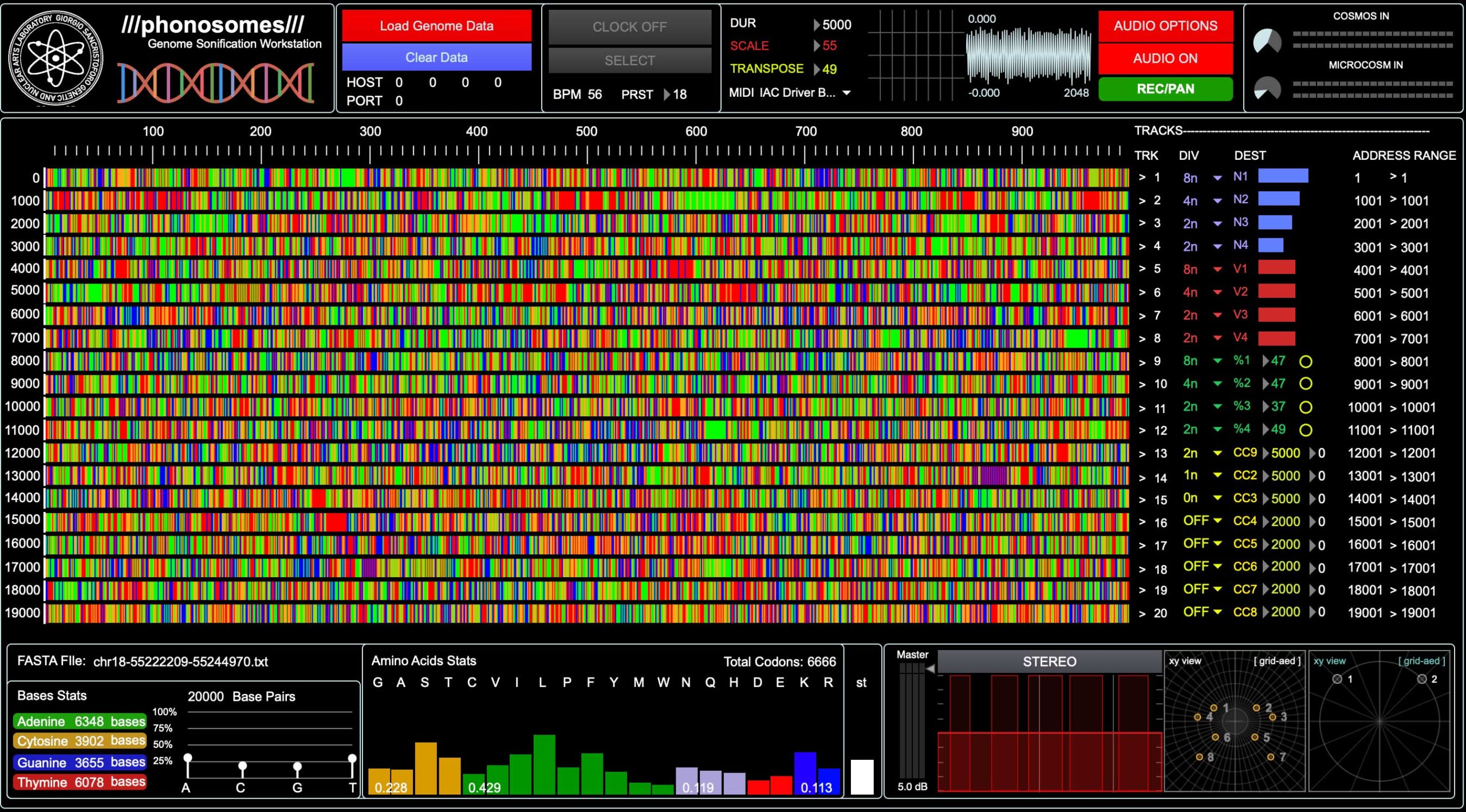
In this collection, I have endeavored to formulate an epilogue of the six years I dedicated to the sonification of my genome. These pieces are the result of hundreds and hundreds of hours of research and experimentation, navigating the vast ocean of information contained within each of our cells. I have sought to translate the complex code of life into sonic textures that could acoustically convey – at least in part – the complexity and diversity of human DNA.
Each sonification is always a compromise, always the result of a choice, but once the translation criteria are established, all that remains is to give voice to the genes and listen.
CREATURE FROM THE ID
In the United States, in the 1950s, electronic music found its epicenter at Columbia University and among the so-called “New York School” circle led by John Cage. However, alongside serial music and Cage’s aleatory compositions, another form of electronic music emerged on the East Coast of the United States, thanks to two sound designers employed by Hollywood: Louis and Bebe Barron.
The Barrons were not interested in serialism and musique concrète but developed an entirely original idea, partly due to the limited resources available to them. Besides magnetic tape and a few function generators, Louis Barron approached the challenge of new music by creating electronic circuits capable of self-generating musical articulations. In a sense, we could say that the Barrons’ work created a concept of generative music. Today, self-generating patches are very popular on modular synthesizers, but in the 1950s, the idea of a circuit not only capable of generating sounds but also articulating them in a complex way, was completely unprecedented with the exception of the giant and clumsy RCA synthesizer. The Barron’s circuits were based on tube oscillators, modulators, and filters, connected in feedback loops to amplify instability and transform it into a new music language, their inspiration was Norbert Wiener’s Cybernetics.
All of this happened at least 10 years before the creation of the first modern voltage-controlled analog synthesizer. The concept of control voltage was completely unknown to the Barrons; for example, the envelope generator and the sequencer were absolutely unimaginable at that time. However, if we listen to the Barrons’ work on “Forbidden Planet” (MGM 1956), it is evident that, in addition to classic tape editing, they had developed circuits capable of modifying the amplitude, duration, timbre, and frequency of sounds, using other techniques. These techniques, after all, were not a secret; they were already part of the cultural knowledge of any competent electronic engineer.
For example, to create a volume envelope, one could take a low-frequency square wave and filter it with a first order high-pass filter and a first order low-pass filter. The result would then pass through a wave rectifier and be applied to a ring modulator, which would serve as a VCA.
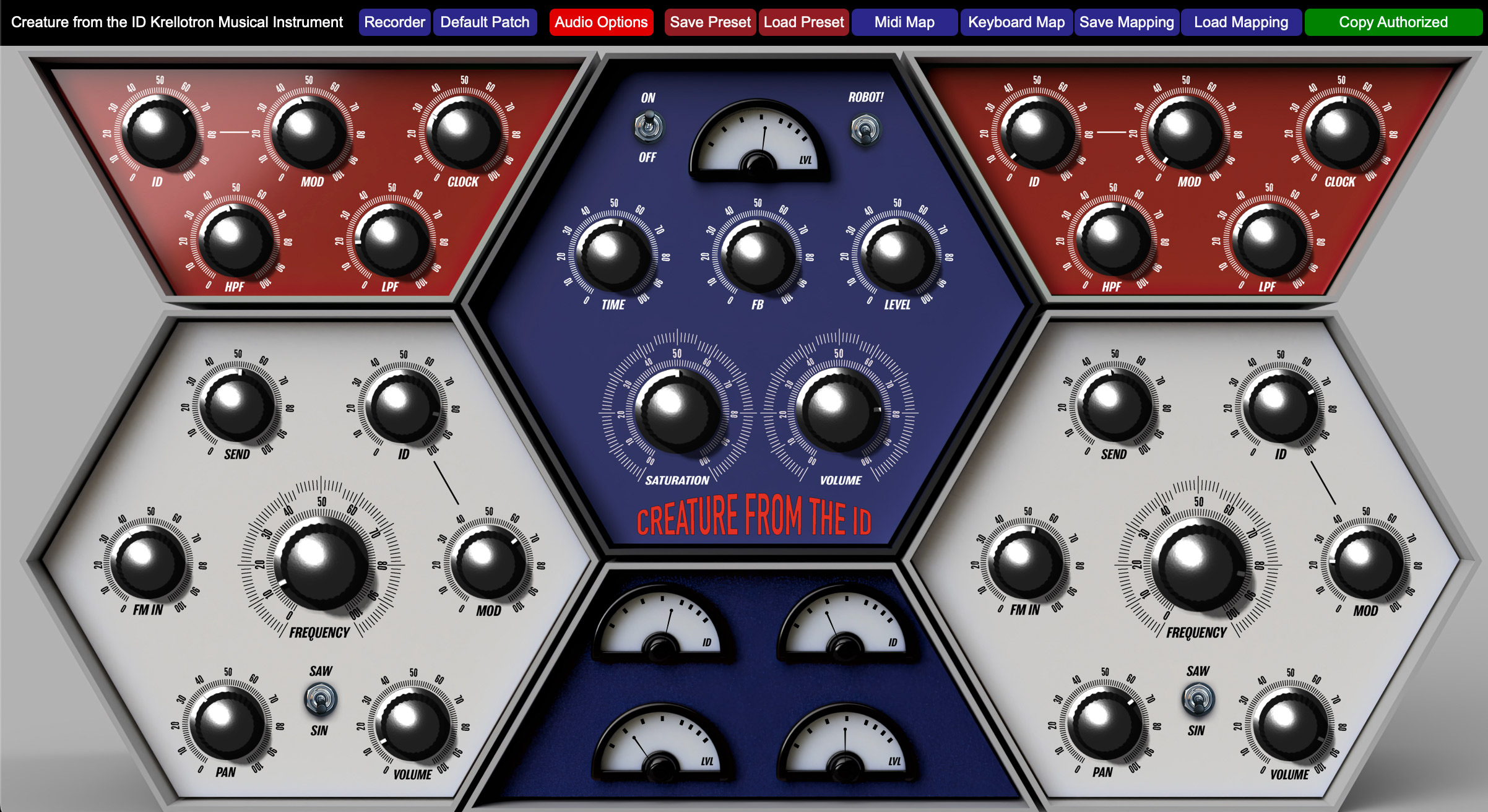
“Creature From the ID” is a software inspired by the pioneering work of the Barrons, designed to emulate their self-generating circuits using only the (virtual) techniques available in the 1950s, thus avoiding the tools of control voltage of the classic synthesizer.
With “Creature From the ID” I challenged myself, simply by listening to the Barrons’ work and reading the very few available pieces of information published on the internet, to recreate as faithfully as possible their sounds.
This is not a work of reverse engineering because I have not gained any access to the documents of the foundation that manages the Barron archive, despite having requested it.Unfortunately, I received no response.
Therefore, I must be completely honest here; this is pure guesswork. I leave it to you to judge whether I have succeeded in capturing the spirit of those sounds, those years, and that vision of an unlimited and magnificent future that the Barrons so eloquently conveyed through their music. And just to be clear on this, no AI or samples were used in this software.
Creature from the ID is an act of love that honors the Barron’s legacy and a new tool for teachers and students of electronic music who want to explore the history of electronic music in class, outside the mass market software’s paradigms.
As a professor of electronic music, I am and will always be dedicated to creating educational tools accessible to all.
I wish you infinite hours of joyful sounds.
Milan, June 2024
CODEX NATURAE
LIVE PERFORMANCE WORK IN PROGRESS
Paraphrasing the famous quote by Galileo, the book of life is written in the language of the genetic code. This code, shared by all living beings on this planet, be they bacteria, viruses, flowers, insects, or large mammals, serves as the operating system of life. The secret behind the immense diversification of living species lies in the propensity of this book to mutate and dynamically interact with its environment.
In 2018, the sci-artist and sound designer Giorgio Sancristoforo developed a system of base 4 numerical translation and sonification of DNA nucleotide sequences called “phonosomic code” at the Joint Research Centre of the European Commission.
By means of this algorithm implemented in a bioinformatics software created by the author, it becomes possible to use the genome as a programming language for a multimedia performance, defining the architecture of instruments and their score using the nucleotide triplets. Furthermore, the versatility of the phonosomic code allows for the exploitation of genetic mutations as vehicles for transforming images and sound.
In CODEX NATURAE the genome becomes a multimedia experience that can be explored through the spectator’s senses, enabling the perception of patterns hidden at the core of life itself.
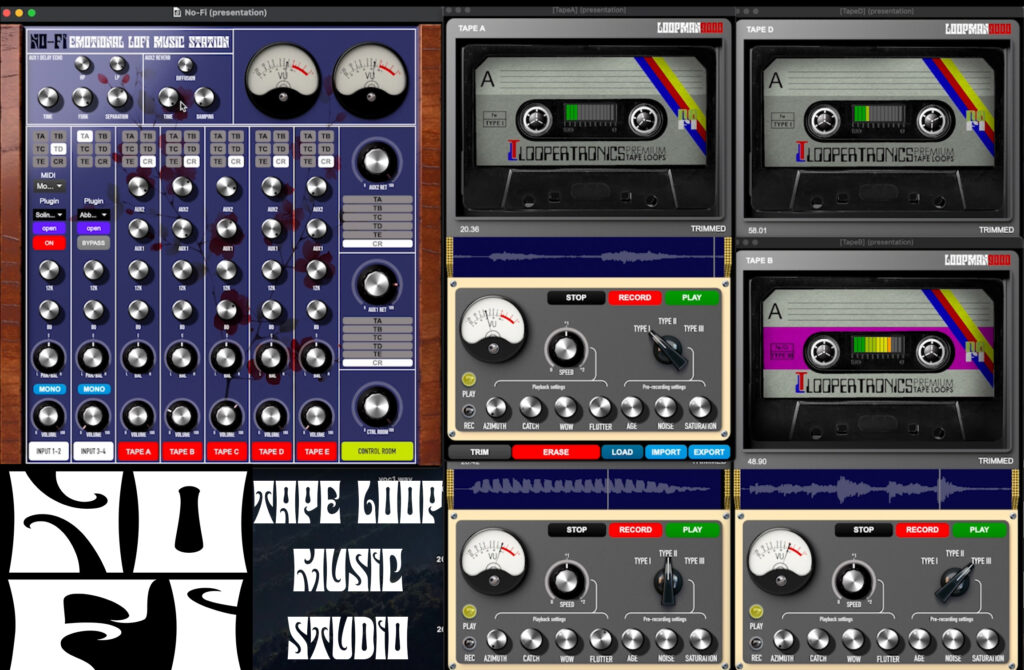
NO-FI TAPE LOOPS MUSIC STUDIO
No-Fi is a tape loop studio software made to revolutionize your creativity with warm lo-fi sound and striking simplicity!
No-Fi is not a plugin and no other software is needed, it’s standalone:
Simplicity here is paramount.
Plug-in, record and mix, just like the real hardware.
You have one mixer, five cassette loopers, one handy reverb and one delay. That’s it!
TRY THE TEMO AND GET INFO IN THE SOFTWARE PAGE
The history of what we call electronic music, not merely understood as music created using technology but as an entirely new form of music endowed with its own syntax and symbolism, where the creation of new sounds evolves side to side with a new way of organizing sound, begins in the 1951 in Europe at the radio studios of WDR in Cologne and in 1954 at RAI in Milan, almost coinciding with the birth of musique concrète at the GRMC in Paris. Almost at the same time, other radio studios and university institutions began to take an interest in this new music, including those in the United States, Poland, the Soviet Union, Japan, and later, the United Kingdom.
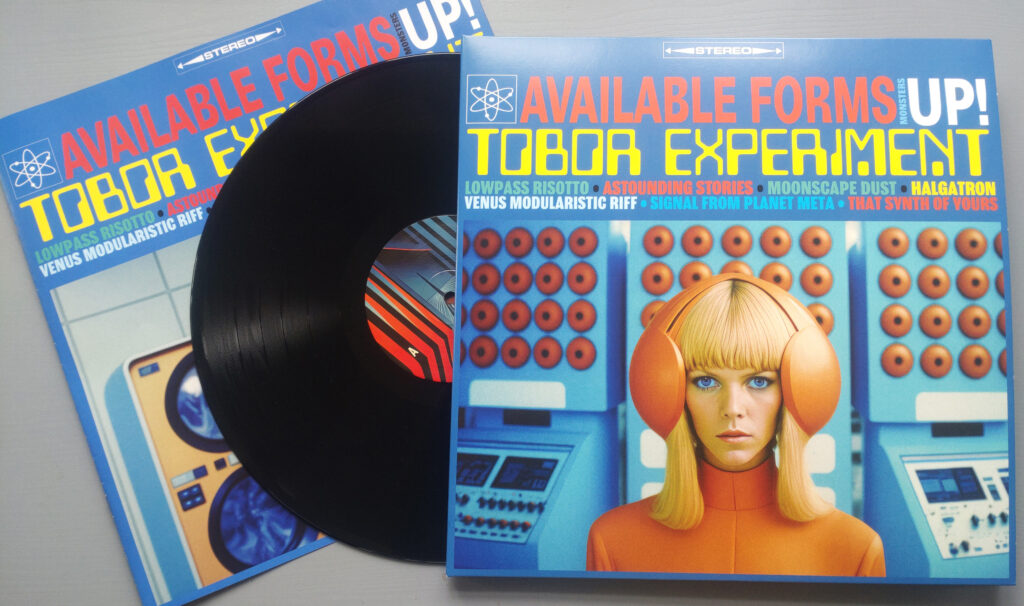
We’re thrilled to announce the return of Tobor Experiment, the visionary musical project led by the enigmatic Giorgio Sancristoforo, to the Bearfunk fold. After a twelve-year hiatus, Tobor Experiment emerges from the shadows with their second LP, “Available Forms”. Picture the ethereal ambiance of a dimly lit jazz club colliding with the futuristic vibrations of a 1970s sci-fi TV show, and you’ll begin to grasp the sonic experience that awaits. Giorgio draws on a whole host of musical inspirations, from the name checked Tim Gane & Letitia Sadier to the moog pioneers Claude Denjean & Jean Jaques Perrey. With the moogsploration of contemporary jazz Tobor Experiment invites listeners on an extraordinary musical odyssey where jazz meets electronica meets nu-disco.
Prepare to be captivated from the very first note of the infectious opener, “Lowpass Risotto” as Tobor Experiment masterfully combines familiar elements with their unique artistic vision. Resonating with undertones reminiscent of the timeless classic “Take Five” the track immediately grabs your attention. While the familiar drum shuffle sets a comforting foundation, Tobor Experiment takes an unexpected twist by infusing the composition with squelchy Moog lines and captivating hollow body guitar solos. The result is a harmonious blend of nostalgia and innovation that transports you to an entirely new sonic realm.
Continuing the journey, the mesmerizing 6/8 rhythm of “Up!” pays homage to the iconic sounds of Stereolab while showcasing Tobor Experiment’s innovative spirit. As enchanting synth pads weave through the air, you find yourself immersed in a dream-like state, carried away by the hypnotic shifting patterns of the bass and drums.
With “Astounding Stories” Tobor Experiment returns to the energetic vibes of the album opener, inviting you to surrender to a sonic tapestry rich with musical exchanges. In traditional jazz style we receive solo’s from all parties. Each instrument adding its unique voice to the narrative, creating a dynamic and engaging musical conversation.
As the album progresses, “Moonscape Dust” emerges, drawing inspiration from the atmospheric brilliance of “Low.” This track serves as a portal to an otherworldly sonic landscape where time and space lose their hold. Here, organic drums step aside, making way for a low-fi drum pattern that lays the foundation for ethereal synth pads. The composition invites you to explore the depths of your imagination, transcending earthly boundaries and allowing you to float in an immersive soundscape.
The album’s closing track, “Monsters” has an air of “Air” about it… the ethereal synths beckon you to surrender to the weightlessness of space, just allow yourself to be carried away by the infectious rhythms, intricate melodies, and atmospheric textures that shape this extraordinary musical journey.
Each track on “Available Forms” showcases Tobor Experiment’s exceptional ability to transcend musical boundaries, creating a genre-bending album that defies all expectations. From start to finish, the soundscape presented is a testament to Tobor’s relentless pursuit of musical innovation. Each composition is a fusion of diverse elements, seamlessly blending organic instruments and electronic textures in a way that challenges traditional genre classifications.
The AI-generated artwork serves as a portal to an alternate dimension. Paying homage to the retro-futuristic aesthetic of 1970s science fiction TV shows, it captures the essence of the album’s fusion between organic and electronic realms.
Preorder gatefold vinyl 12″ with 8 pages color booklet here
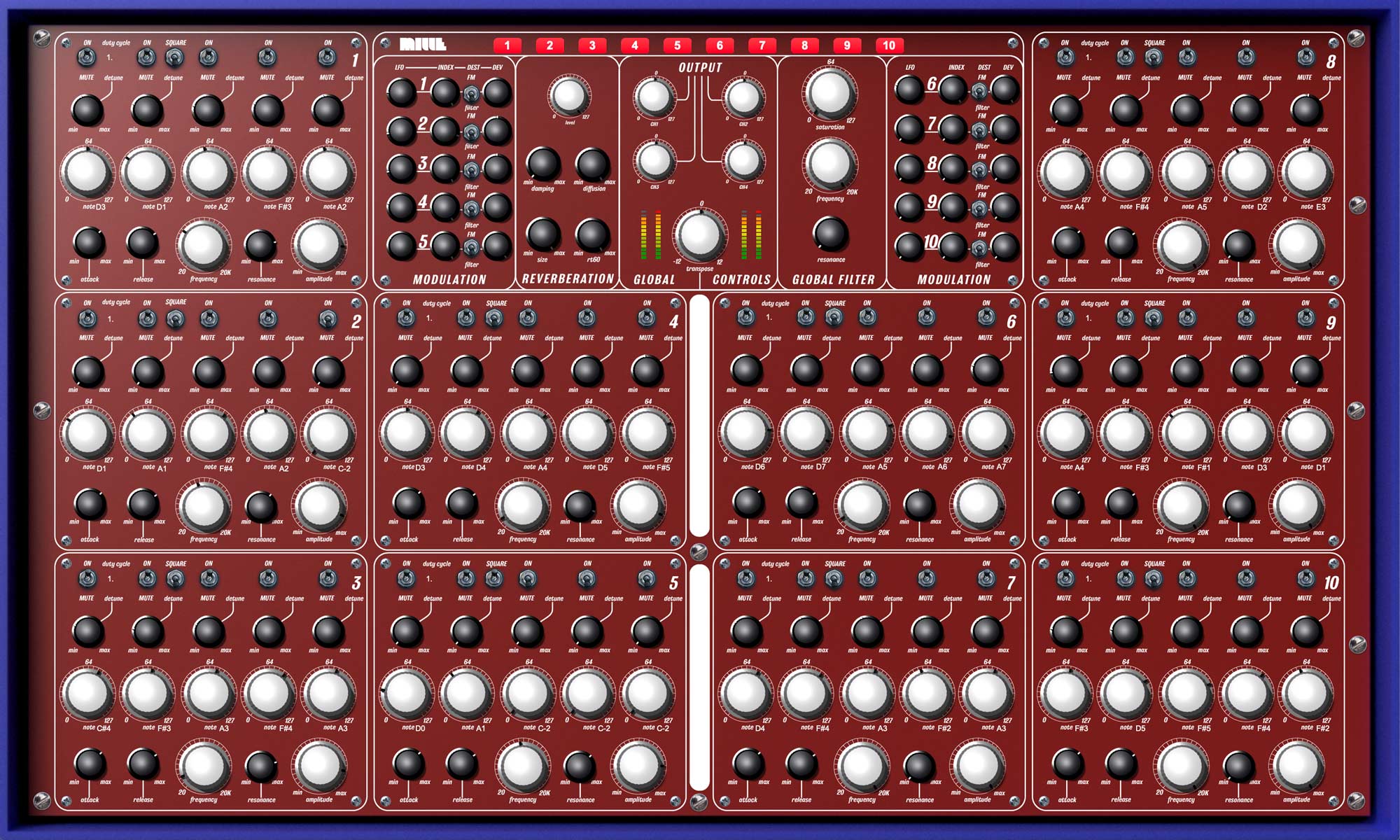
Mille is a standalone 1000 oscillators (200 filters and 200 LFOs) drone synthesizer with an 8 track recorder and surround spatialisation (2 or 4 channels).
Thanks to its architecture, Mille can create amazing dense and evolving drones that sound HUGE. Programming all these oscillators is simple and fast, do not get scared. Whether you look for “angelic choirs” or total chaos, Mille will serve you with an astounding number of resources that will sound like nothing else, and yes you can saturate everything like hell.
See the Software Page for details and DEMO (Apple Silicon M1-M2 STRONGLY SUGGESTED)